
What Probate Covers in Lancaster County
Probate is the legal process that settles an estate after someone dies. In Lancaster County it runs through the Register of Wills and Clerk of Orphans' Court. The office handles the probate of decedent estates, collects inheritance taxes, issues marriage licenses, and keeps records for adoptions, guardianships, and estates. When a person leaves a valid will, the office proves the will and names an executor. When there is no will, it appoints an administrator under state law. Either way, a public estate file opens and tracks the steps that follow.
Orphans' Court is the part of the Court of Common Pleas that hears these matters. It steps in when a case needs a judge. Contested wills, guardianships, adjudication of incapacity, adoptions, and disputes over an estate all land in Orphans' Court. The Register of Wills opens and keeps the file. The Orphans' Court judge decides the issues that the office cannot settle on its own. So the two work side by side under one roof.
The office sits on the second floor of the courthouse in downtown Lancaster. You can see the office, its staff, and its full list of duties on the county site.
The county links the Register of Wills office from its main directory of offices and services.
The Lancaster County Register of Wills page lays out the probate, estate, marriage, and Orphans' Court duties in one place.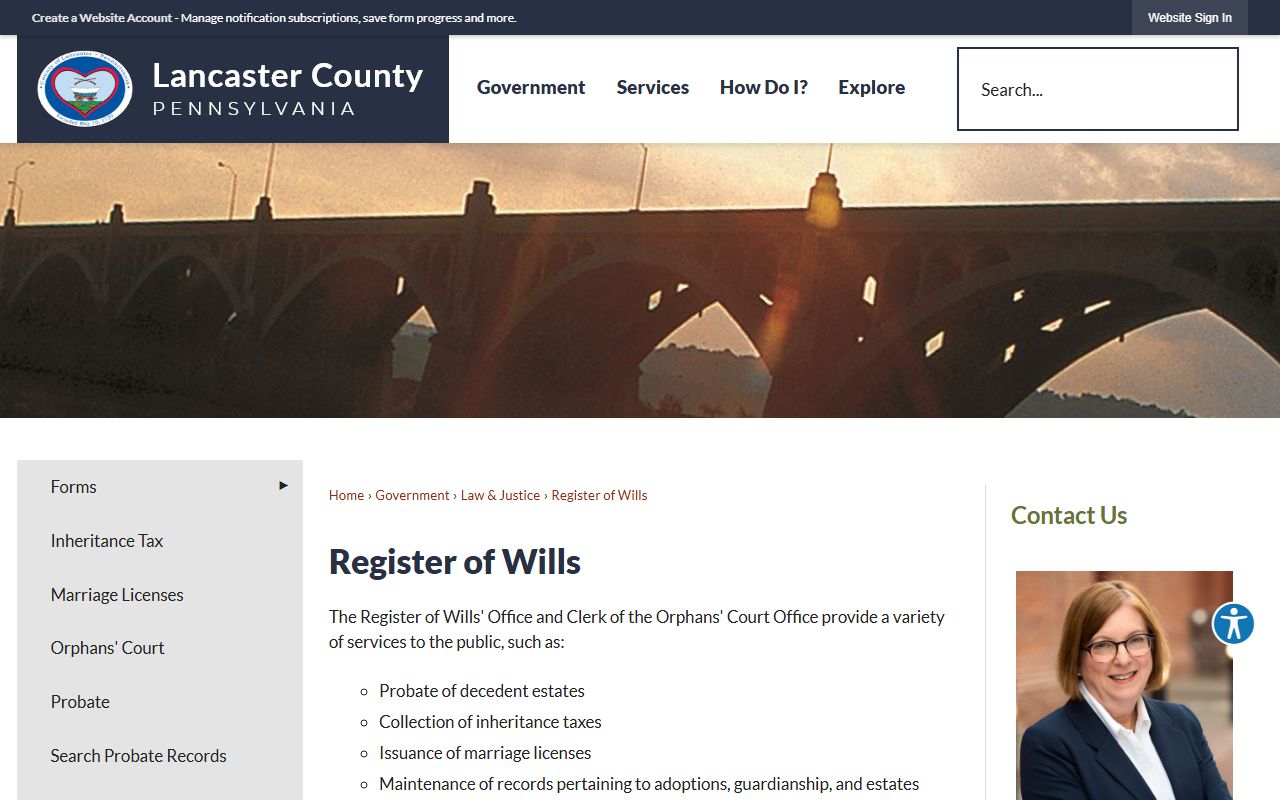
That page also names the divisions inside the office, which helps you reach the right clerk for an estate, a tax return, or a guardianship.
Lancaster County Probate Terms Defined
Probate uses words that throw off new readers. A quick guide helps you read a Lancaster County estate file without guessing. The terms below come up again and again on petitions, letters, and Orphans' Court orders. Learn these few and the rest of the file makes more sense.
- Testator
- A person who leaves a valid will at death.
- Executor
- The person a will names to settle the estate and carry out its terms.
- Intestate
- Dying with no valid will, so state law sets who inherits and who can serve.
- Letters Testamentary
- The papers the Register issues to an executor when there is a valid will. They prove the right to act for the estate.
- Guardianship
- A court arrangement that gives one person legal authority over the person or assets of someone who cannot manage alone, such as a minor or an incapacitated adult.
- Conservatorship / Incapacity
- An Orphans' Court finding that an adult cannot handle their own affairs, paired with an order naming someone to manage their care or money.
How to Search Lancaster County Orphans' Court Records
The search starts with the right tool. Lancaster County links a Paperless Search for probate and marriage records, so most name and estate lookups begin online. Not every document shows on the portal. Older files, sealed matters, and full estate papers may sit only at the office counter. So a portal hit is a starting point, and the office holds the rest. Plan to follow up in person or by mail for a certified copy.
Before you start, gather what you have. A decedent's full name helps most. A date of death, an estate file number, or the executor's name narrows it fast. The Paperless Search runs through a legacy county system that also carries marriage records, so it works for both.
The county's Search Probate Records page points to the public lookup tool for estate and probate files.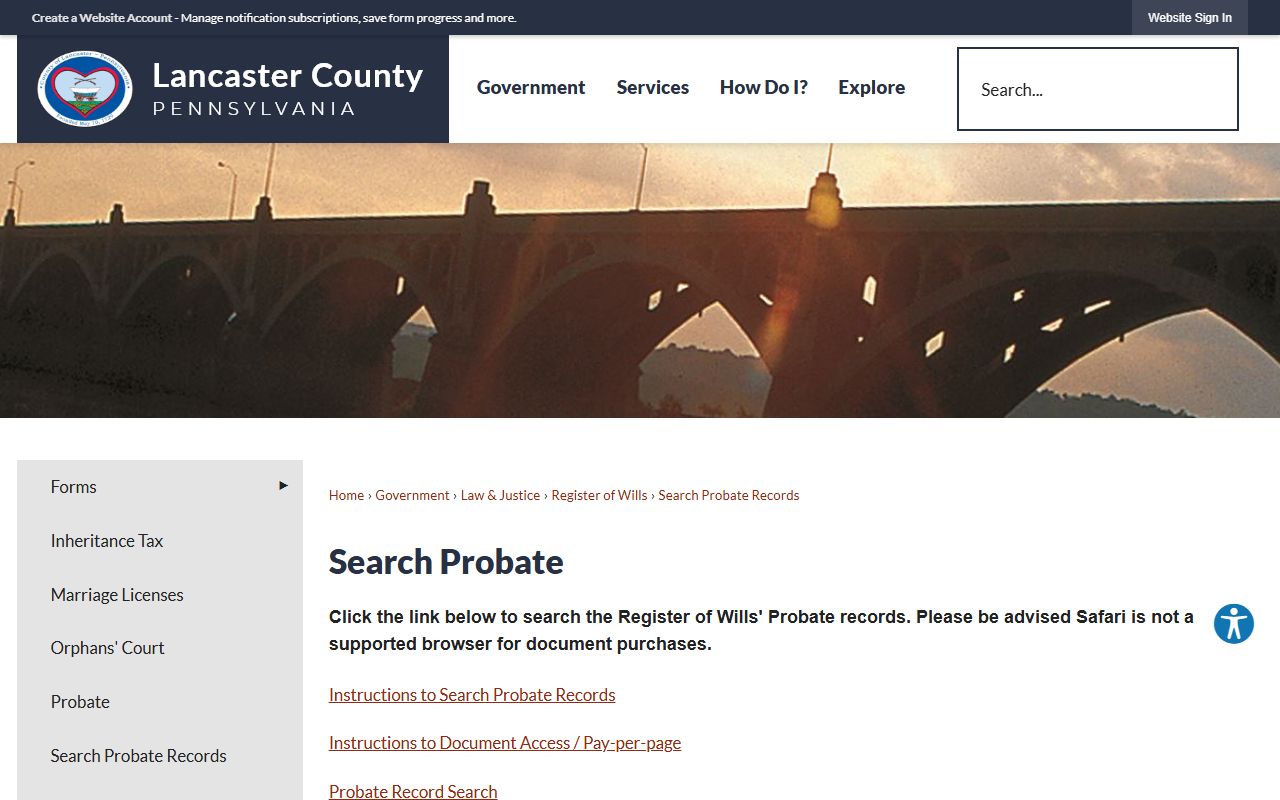
From there the county sends you to the Paperless Search system that holds the indexed probate and marriage entries.
- Open the county Search Probate Records page and follow the link to the Paperless Search tool.
- Enter the decedent's name, and add an estate number or date if you have one.
- Open the matching entry and note the estate file number and the names tied to it.
- Request a certified copy or a full estate file from the Register of Wills if you need the documents.
The Paperless Search lives on a separate county server. You can reach the live tool directly when the county page sends you over.
The Lancaster County Paperless Search system indexes both probate and marriage records in one place.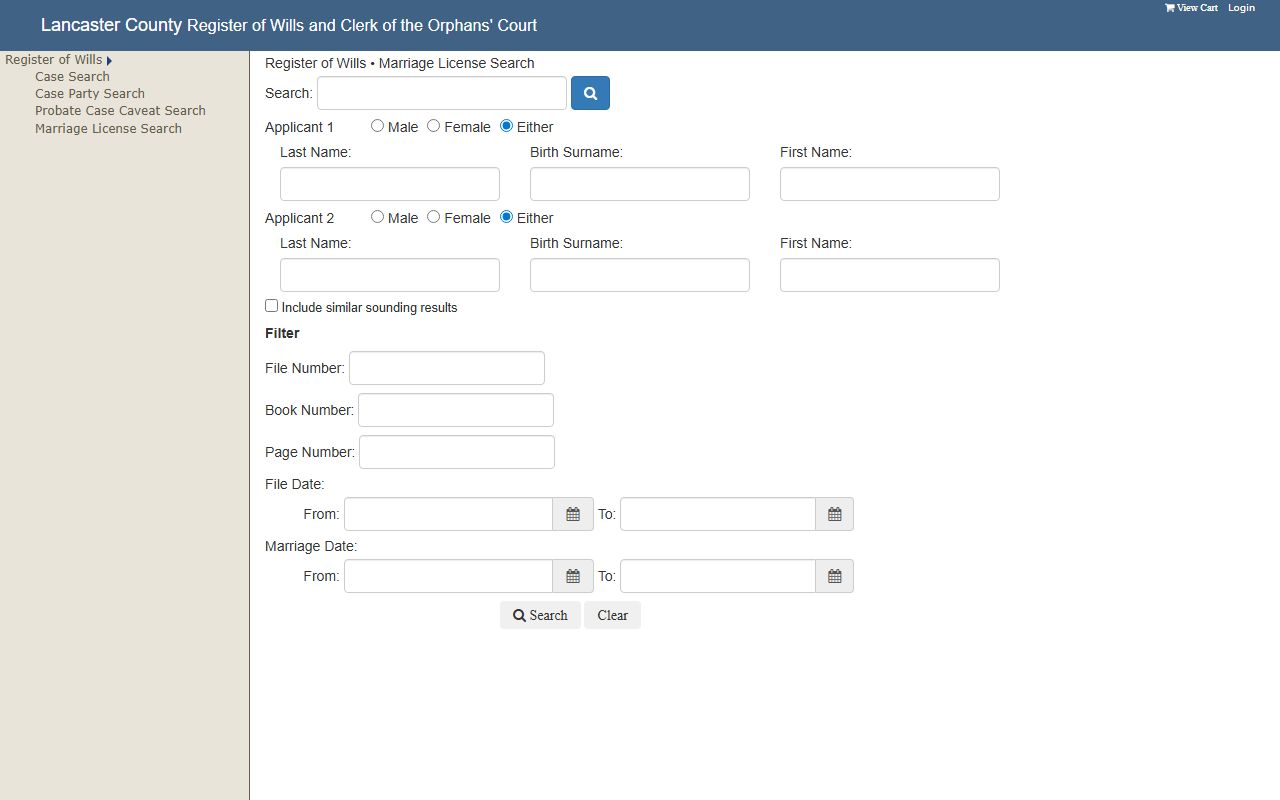
Because that tool carries marriage records too, a single search can surface both an estate and a license tied to the same name.
Note: The online index points you to a file, but a certified copy for legal use still comes from the Register of Wills office counter or by written request.
The Register of Wills and Orphans' Court in Lancaster County
One office runs probate for the whole county. The Register of Wills is Anne L. Cooper, who also serves as Clerk of the Orphans' Court. The office proves wills, opens estates, issues Letters Testamentary and Letters of Administration, processes inheritance tax, and keeps adoption, guardianship, and estate records. It works on the second floor of the courthouse at 50 North Duke Street. Several divisions split the work, so a caller can reach the right clerk for the task at hand.
Chief Deputy Emily A. Carello oversees the office. Brenda Huber serves as Probate Clerk for estates. Elridge Castillo is the Deputy Clerk of Orphans' Court for adoptions and guardianship. Kelly Nelson handles the Inheritance Tax Division. A separate Marriage Hotline answers license questions at 717-295-3533. The contact card below holds the main office details for probate and estate work.
Register of Wills / Clerk of Orphans' Court
50 N. Duke St., 2nd Floor
Lancaster, PA 17602
717-295-5994
Mon-Fri 8:30 a.m.-4:30 p.m.
The county keeps a dedicated probate page that walks through opening an estate and filing a petition.
The Lancaster County Probate page explains how the office proves a will and issues letters to a personal representative.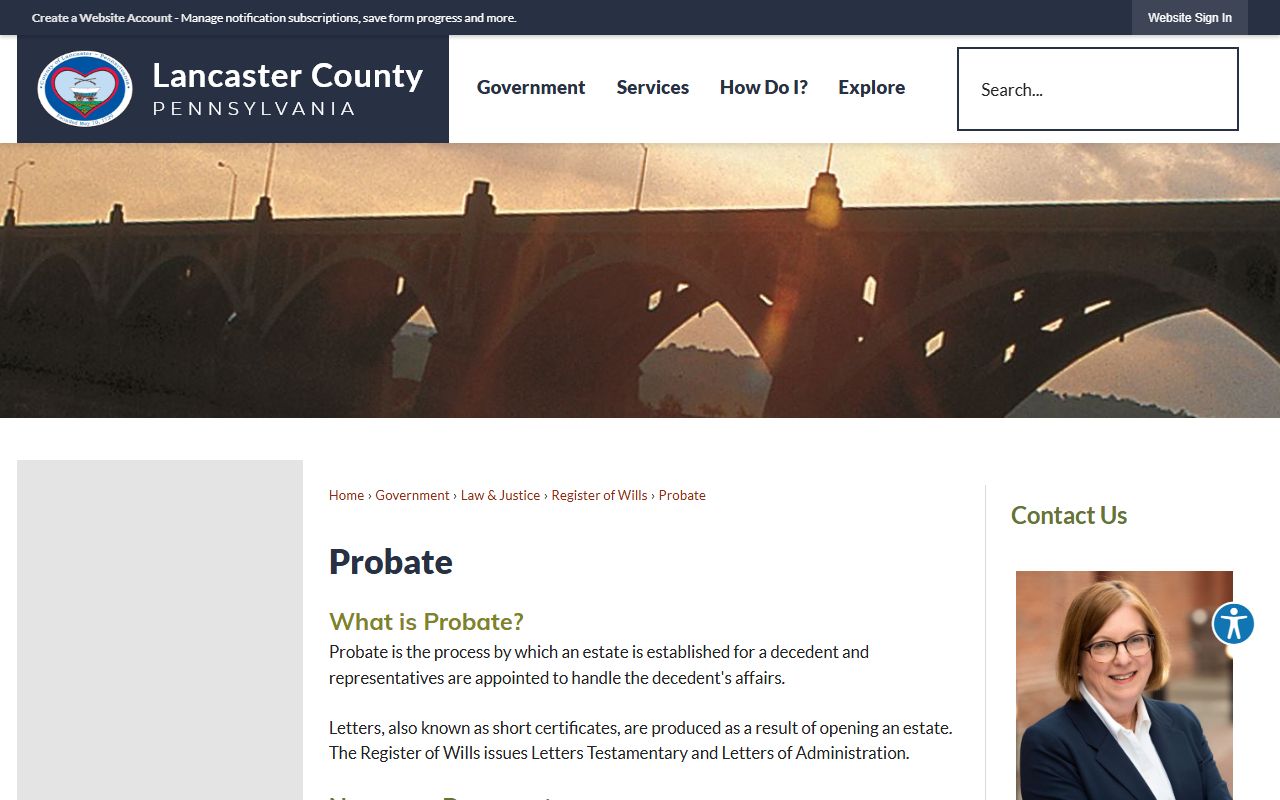
That page makes clear that a Petition for Grant of Letters is filed in person, with virtual handling allowed only by special exception.
Opening a Lancaster County Estate
Opening an estate follows a set order. The personal representative files first, then handles notice, debts, taxes, and the final split among heirs. A Petition for Grant of Letters is filed in person at the Register of Wills. The office issues Letters Testamentary when there is a valid will and a named executor. It issues Letters of Administration when there is no valid will, so the court must name an administrator. From there the representative does the long work of settling the estate.
The steps below show the path most Lancaster County estates take. Bring the right papers to the counter and the first visit goes faster.
- Decide whether an estate must be opened at all, since small or jointly held assets may not need probate.
- Gather the death certificate, the original will if one exists, a list of assets, the names of heirs or beneficiaries, and your own photo ID.
- File the Petition for Grant of Letters in person at the Register of Wills, unless a special exception allows another method.
- Receive Letters Testamentary or Letters of Administration, which prove your authority to act for the estate.
- Handle notice to heirs, the estate inventory, debts, and the inheritance tax return.
- Take any contested matter, guardianship, or incapacity issue to Orphans' Court for a judge to decide.
Inheritance tax is its own track. Returns and payments may be filed right at the counter. A mailed payment uses the envelope postmark as its filing date, which matters when a deadline is close. The Orphans' Court page covers the judge-side matters that grow out of an estate.
The Lancaster County Orphans' Court page describes the contested estate, guardianship, and incapacity matters the court decides.
That page is the right stop when an estate moves past routine paperwork and needs a judge to weigh in.
Lancaster County Probate Record Fees
Fees depend on the record and the service. The Register of Wills publishes set fees for marriage records and a per-page copy fee, but the county does not post a full probate filing-fee table on its public pages. Probate filing costs can change and often scale with the estate, so confirm the current amount with the office before you file or mail a payment. The fees below are the ones documented for the office.
| Item | Amount |
|---|---|
| Marriage application and license | $60 |
| Certified marriage copy | $10 |
| Plain copy | $0.25 per page |
| Probate and estate filing fees | Confirm with the Register of Wills |
Many offices do not take personal checks, so ask about payment before you visit. For a certified copy of an estate document, plan for a copy fee on top of any filing cost. The office can quote the full amount for the document you need.
What Lancaster County Probate Records Show
A probate file tracks an estate from start to close. At its core sits the will, if one exists, and the petition that opened the case. From there the file grows. It can hold the Letters Testamentary or Letters of Administration, the inventory of assets, the inheritance tax return, accountings, and the final distribution among heirs. The names of the executor or administrator and the heirs appear throughout. So a single estate file can paint a full picture of who got what and when.
Marriage records sit with the same office, which is why a probate search and a marriage search often share a portal. An estate file also notes key dates: the date of death, the date letters were granted, and the dates of major filings. The list below covers the items you are most likely to find when you open a Lancaster County estate file.
- The will - the original probated document, when the decedent left one.
- Petition and letters - the Grant of Letters petition and the Letters Testamentary or Administration that followed.
- Inventory - the list of estate assets and their values.
- Inheritance tax return - the filing that reports and pays state inheritance tax.
- Accountings and distribution - records of how the estate paid debts and split the rest.
Restricted Lancaster County Orphans' Court Records
Not every Orphans' Court file is open. Ordinary estate records are generally public, so most wills and estate files can be viewed or copied. But the same office keeps records that the law shields. Adoption files are confidential. So are incapacity records and many minor-guardianship files. A sealed Orphans' Court matter stays out of public view as well. The office keeps these apart from routine estate paperwork even though one counter handles them all.
To view a closed file, a person usually needs to be a party, an attorney, or someone the court has authorized. A petition to the Orphans' Court may be the only way in. For ordinary estate records, the public can search and request copies without that step. When you are unsure whether a record is open, ask the office before you plan a visit.