
Arrest Records in Lancaster County
An arrest record is created when a person is taken into custody. In Lancaster County, that happens through local police, state police, or the Sheriff's Office. The arresting agency writes up the incident, lists the charges, and starts a booking file. When the person is committed to the jail, Lancaster County Prison opens its own custody record. That record shows a booking number, basic details, the commit date, and the agency that made the arrest. This is the first official footprint of a criminal matter, and it forms the core of what people call arrest records.
It helps to keep three things apart. An arrest record reflects a booking. A criminal court record begins later, once charges are filed in court. A conviction record shows only cases that ended in a finding of guilt. An arrest alone proves none of those things. Many arrests never lead to a conviction at all. For the full court file and case history, the court records page covers docket searches in more depth. This page leads with the arrest side first.
Charges and bookings are public in most cases. Some are not. Juvenile arrests, sealed matters, and expunged cases stay out of public view.
How to Search Lancaster County Arrest Records
There is no single button for "recent arrests" in Lancaster County. You pull the picture together from a few official tools. The fastest way to see if someone is in custody right now is the Lancaster County Prison public inmate search. It shows people currently held in the county jail, with a booking number, name, birth date, commit date, and the arresting agency. For charges and case status, the statewide Pennsylvania UJS Case Search shows public criminal dockets. For a formal record letter, you go to the Clerk of Courts. Each tool answers a different question, so use the one that fits.
- Check current custody first. Open the Lancaster County Prison public inmate search and search by last name, first name, birth date, or booking number (PIN).
- Look up charges and case status on the Pennsylvania UJS Case Search. Search by participant name, docket number, OTN, complaint number, or incident number, and pick Lancaster to narrow it.
- For a formal Lancaster County conviction search, mail a written request to the Clerk of Courts with the required details and fee.
- For a statewide criminal history, use the Pennsylvania State Police PATCH system, which reaches beyond Lancaster County.
Gather what you have before you start. A full name, a birth date, or a booking number all cut down on false matches. Common surnames return long lists, so a date of birth helps. If you have a citation or docket number, use it. Common Pleas dockets begin with CP. Magisterial District Court dockets begin with MJ. The county FAQ explains how to look up criminal court records, which is worth a quick read before you dig in.
The county walks through the steps for searching criminal court records on its public FAQ. You can read it at the Lancaster County criminal record search FAQ.
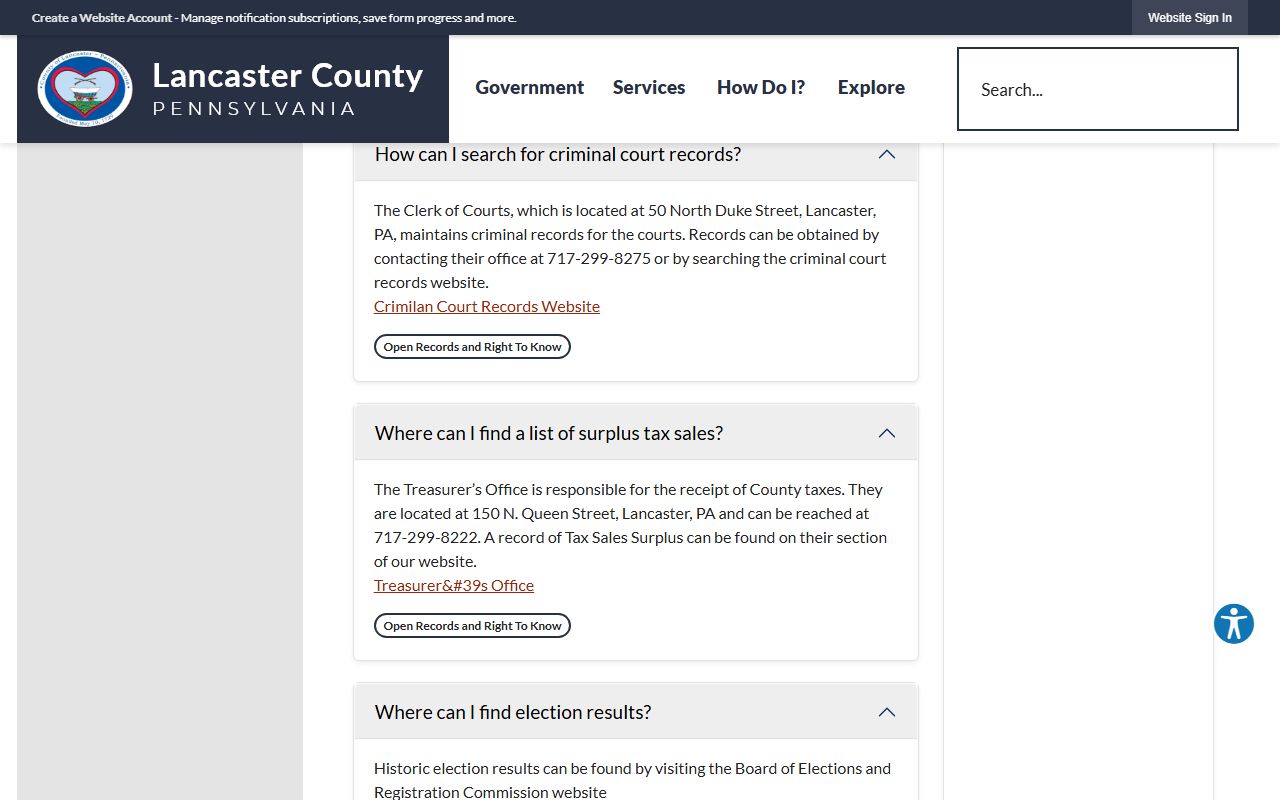
That FAQ points users to UJS for dockets and to the Clerk of Courts for certified records. It is a good map of which office holds which Lancaster County arrest and criminal record.
Arrest Records vs. Criminal Court Records
People mix these two up all the time. An arrest record is made at the moment of arrest and booking. It comes from the police or the jail. A criminal court record is built by the court after charges are filed. It comes from the Clerk of Courts and shows the case as it moves through the system. One is a snapshot of a custody event. The other is a running log of a court case. A person can have an arrest with no court record yet, or a court record long after the arrest itself.
The table below sorts out the main differences. Use the arrest side for recent bookings and jail status. Use the court side for charges, pleas, and outcomes. For the full court file, see the Lancaster County court records page.
| Arrest Record | Criminal Court Record | |
|---|---|---|
| Source | Police, Sheriff, or county jail | Clerk of Courts and the courts |
| Created When | At arrest and booking | After charges are filed |
| Contents | Booking number, name, charges, commit date, arresting agency, mugshot | Complaint, motions, bail, plea, disposition, sentence |
| Where to Search | County inmate search | UJS Case Search and Clerk of Courts |
| Best For | Current custody and recent bookings | Case status and outcomes |
The county inmate search is an operational custody index, not a full criminal history. It tells you who is held now. It does not replace the court docket or a state police report. When the details matter, cross-check more than one system.
Finding Recent Lancaster County Arrests
Most people who want "recent arrests" really want to know if someone is in the county jail. The public inmate search answers that. It lists people currently committed to Lancaster County Prison, so a fresh booking shows up there once intake is done. The result list gives a booking number, the name, birth date, race, sex, the commit date and time, a commit age, and the arresting agency. That last field tells you which department made the arrest, which is useful when you are not sure where the case started.
The tool uses a reCAPTCHA check, so plan to confirm you are not a bot. You can search by first name, last name, birth date, or PIN. To see the live tool and its search fields, use the inmate search portal itself. The roster updates as people are booked in and released, so a name that is missing may mean release, a transfer, or a record not yet posted.
| Field | What It Shows |
|---|---|
| PIN | The local booking number used by the jail system. |
| Name | Last, first, and middle name as entered at booking. |
| Birth Date | Date of birth on file for the person in custody. |
| Race / Sex | Booking demographic fields, not a court finding. |
| Commit Date | The date and time the person was committed to the jail. |
| Arresting Agency | The department tied to the arrest or commitment. |
For the deeper jail roster walkthrough, visitation, and contact details, the Lancaster County inmate records page goes further. If the person you seek is wanted but not in custody, check warrant records next.
Charges vs. Convictions
A charge is an accusation. A conviction is a result. The difference is the whole point of a fair process. When someone is arrested, the agency files charges based on probable cause, a fairly low bar. To convict, the Commonwealth must prove the case beyond a reasonable doubt, a much higher bar. A charge can be dropped, withdrawn, or beaten at trial. It can also end in a diversion program like ARD, which is not a conviction. So an arrest record showing charges does not mean the person was found guilty of anything.
This matters for anyone reading a record. A list of charges on a booking sheet is just the starting accusation. The court docket shows what happened next. Look for the disposition, which is the outcome of each charge. The table lays out the contrast.
| Charge | Conviction | |
|---|---|---|
| Stage | Accusation at or after arrest | Verdict, plea, or finding of guilt |
| Burden of Proof | Probable cause | Beyond a reasonable doubt |
| Can It Change? | Yes, can be dropped or amended | Final unless appealed or vacated |
| Public Record | Yes, unless sealed | Yes, unless sealed or expunged |
A Lancaster County Clerk of Courts record check reports convictions, not raw arrests. If you need the full charge history with outcomes, read the court docket on UJS and pair it with a Clerk letter. DUI cases sit on the criminal side too, and you can read more about them on the traffic court records page.
Lancaster County Criminal Record Check
The Lancaster County Clerk of Courts can issue a formal record-check letter. This is the official county document many people need for a job, a license, or a personal check. It is not done online and it is not done by phone. You mail a written request to the office. The letter reports convictions in Lancaster County only. It does not cover other counties, and it does not cover charges that did not lead to a conviction. For anything statewide, you need the state police instead.
The fee is set by the office. A record search costs $21.50 per search. A certified copy is $8.75 each, and plain copies are $0.25 per page. Send a certified check payable to Clerk of Courts, not a personal check. Include enough detail to make a clean match.
- Write a request that lists the person's name, address, date of birth, full Social Security number, and any aliases.
- Add a certified check for $21.50 made payable to Clerk of Courts.
- Mail it to the Clerk of Courts at the courthouse. Phone requests are not accepted.
- Wait for the mailed letter, which reports Lancaster County convictions only.
The county spells out the request, the fee, and the limits on its official FAQ. You can read the details on the Clerk of Courts criminal record check FAQ.
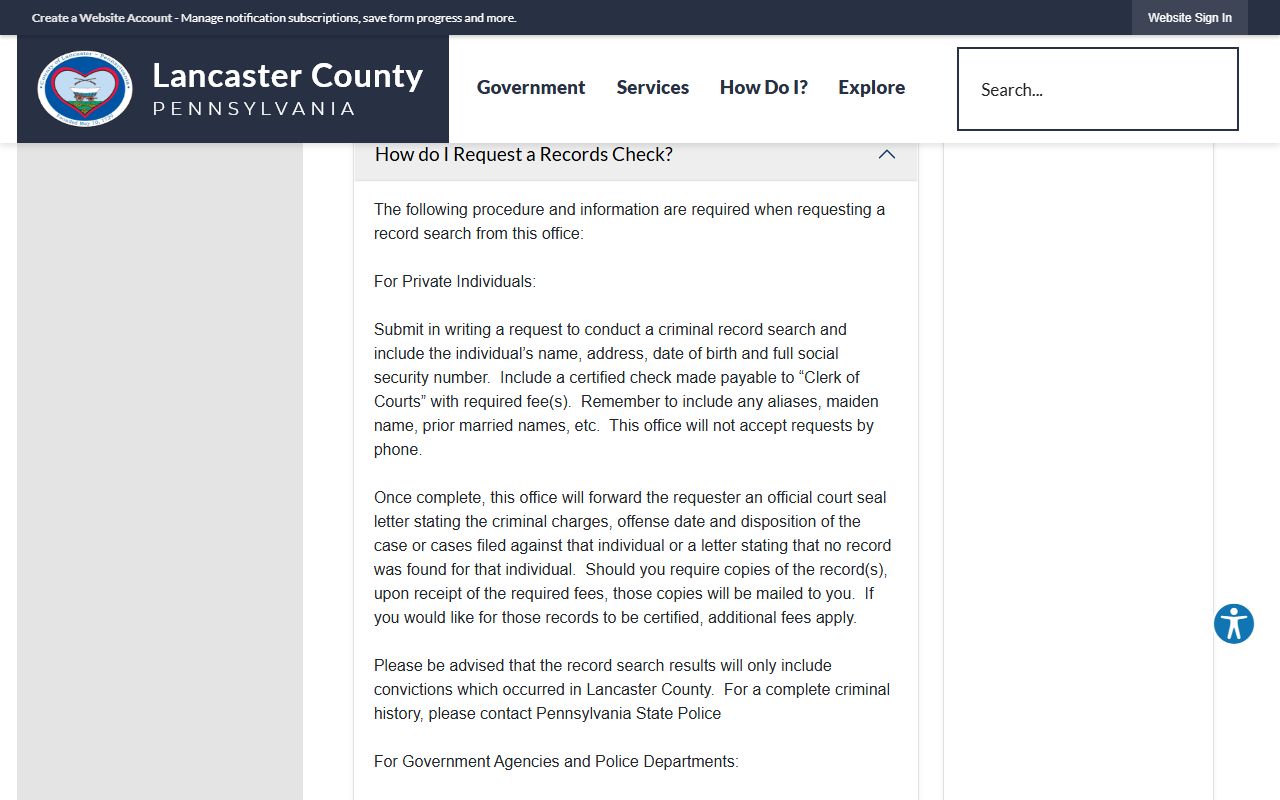
Note the key limit: the county letter covers Lancaster County convictions only, so a clean Lancaster result does not mean a clean record everywhere. The Clerk of Courts page has the full office profile and mailing details.
Statewide Criminal History with PSP PATCH
For a record that reaches across Pennsylvania, the tool is PATCH. PATCH stands for the Pennsylvania Access To Criminal History system, run by the Pennsylvania State Police. It is the official statewide criminal-history channel. A county docket search or a Clerk of Courts letter only covers Lancaster County. PATCH pulls reportable criminal history from across the state. Employers, volunteer groups, and individuals use it for a broad background check. There is a fee, and some requests are free for certain volunteer purposes.
The difference is worth repeating. A UJS docket search and a Clerk record check are court-record tools tied to Lancaster County. PATCH is the state criminal-history request system. If a job or license asks for a statewide background check, a county docket print is not the same thing.
The state police explain the request process, the fees, and what the report covers. Start at the Pennsylvania State Police PATCH background check page.
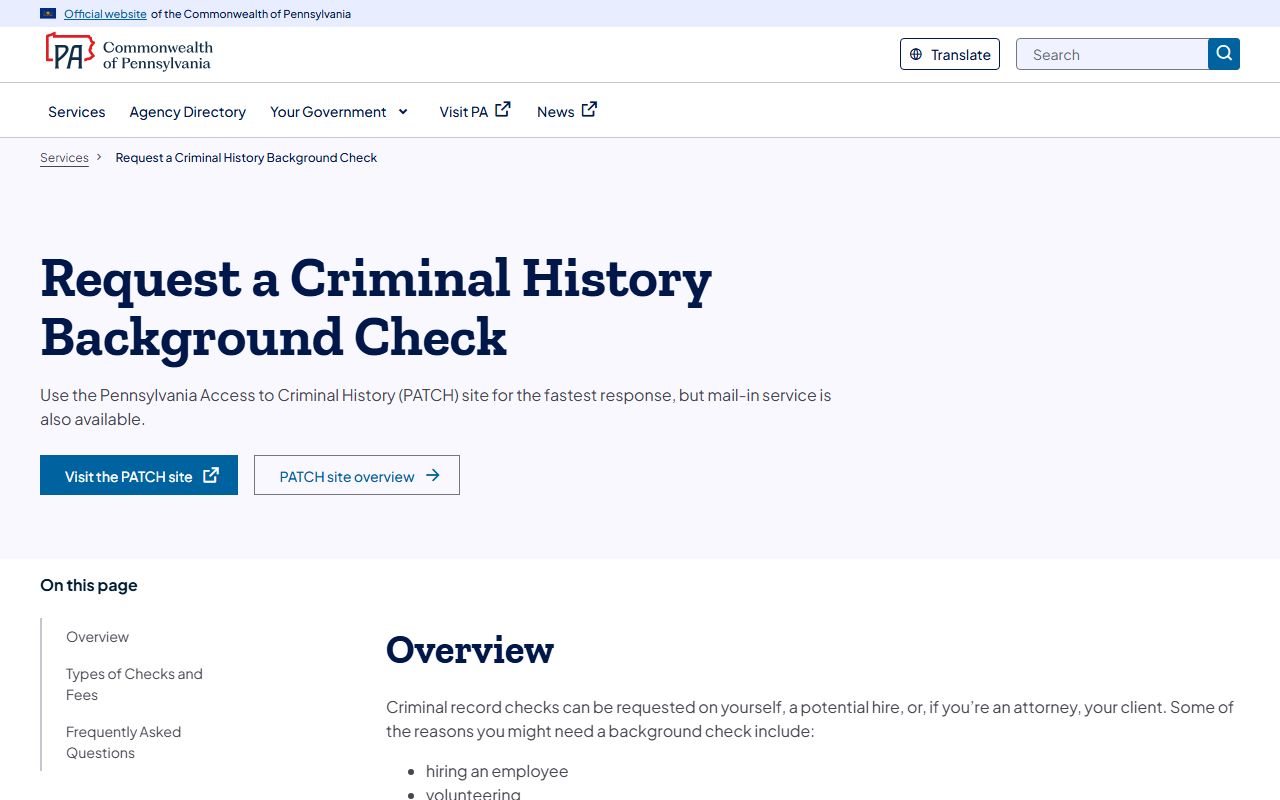
PATCH also matters for expungement. After a court grants an order, the state police update the criminal history once they receive that order from the Clerk of Courts. So the county and the state pieces work together.
The Lancaster County District Attorney
The Lancaster County Office of the District Attorney prosecutes criminal cases in the county. The District Attorney is Heather L. Adams. The office investigates and prosecutes crime, defends crime-victim rights, and works with police departments across Lancaster County. It runs with about 28 attorneys who handle felony and misdemeanor cases plus appeals. A detectives unit, a drug task force, and a computer forensic unit support that work. The office sits in the courthouse at 50 North Duke Street in the city of Lancaster.
The DA is not a court clerk, so it does not keep the public docket. But its work shapes the charges you see on an arrest record. Filing decisions, plea offers, and diversion options all flow from this office.
You can learn about the office, its units, and contact details on the official county page. Visit the Lancaster County District Attorney page.
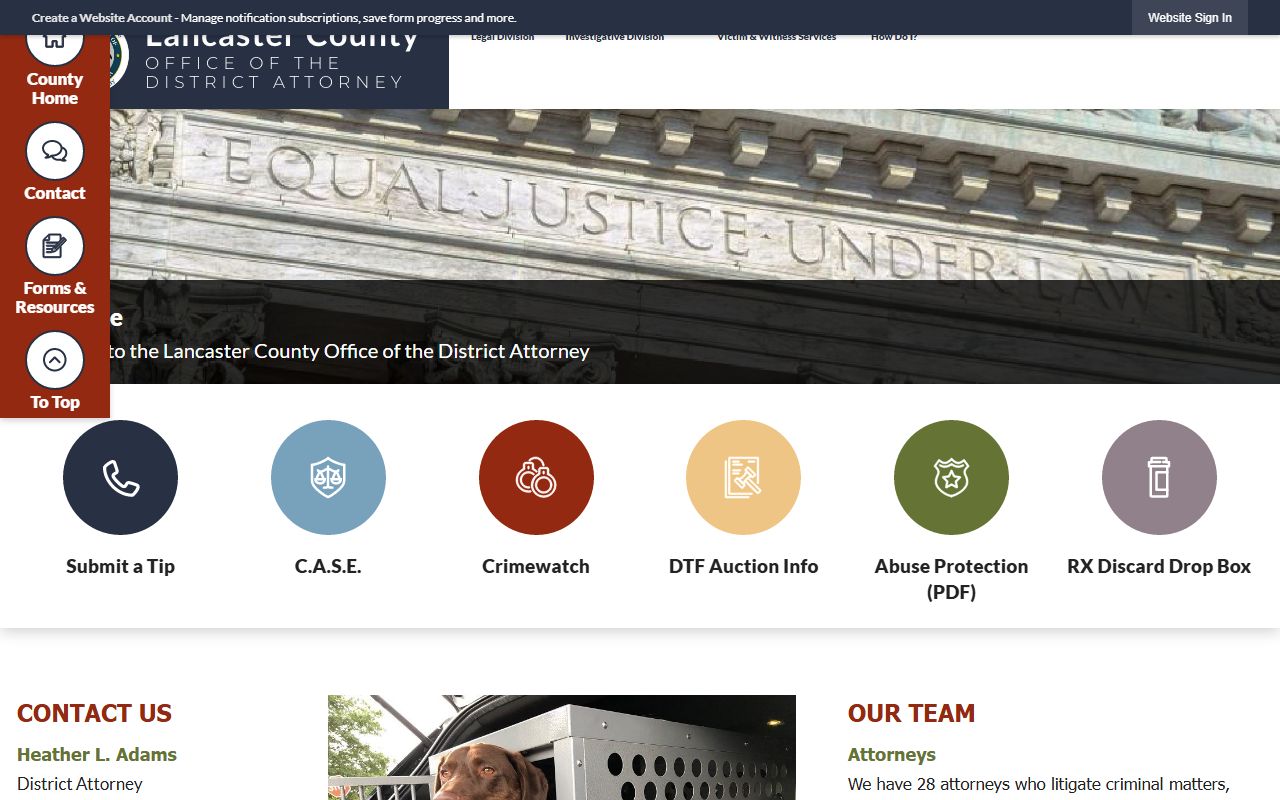
For court dockets and filed charges, you still use UJS or the Clerk of Courts. The DA page is the place to understand who prosecutes Lancaster County arrest and criminal cases.
Victim and Witness Services
Victims and witnesses have rights in the process, and Lancaster County has a program to support them. Victim/Witness Services is run under the District Attorney. Advocates act as a liaison between victims, witnesses, and the office. They help people understand case status, court dates, and the steps of a criminal matter. If an arrest record touches you as a victim, this is the office to call. It connects directly to how a case moves after the arrest.
For custody-status alerts, victims can also register through statewide notification tools described on the released inmates page. Local support, though, starts here.
The program's role, contacts, and resources are posted by the county. See the Lancaster County Victim/Witness Services page.
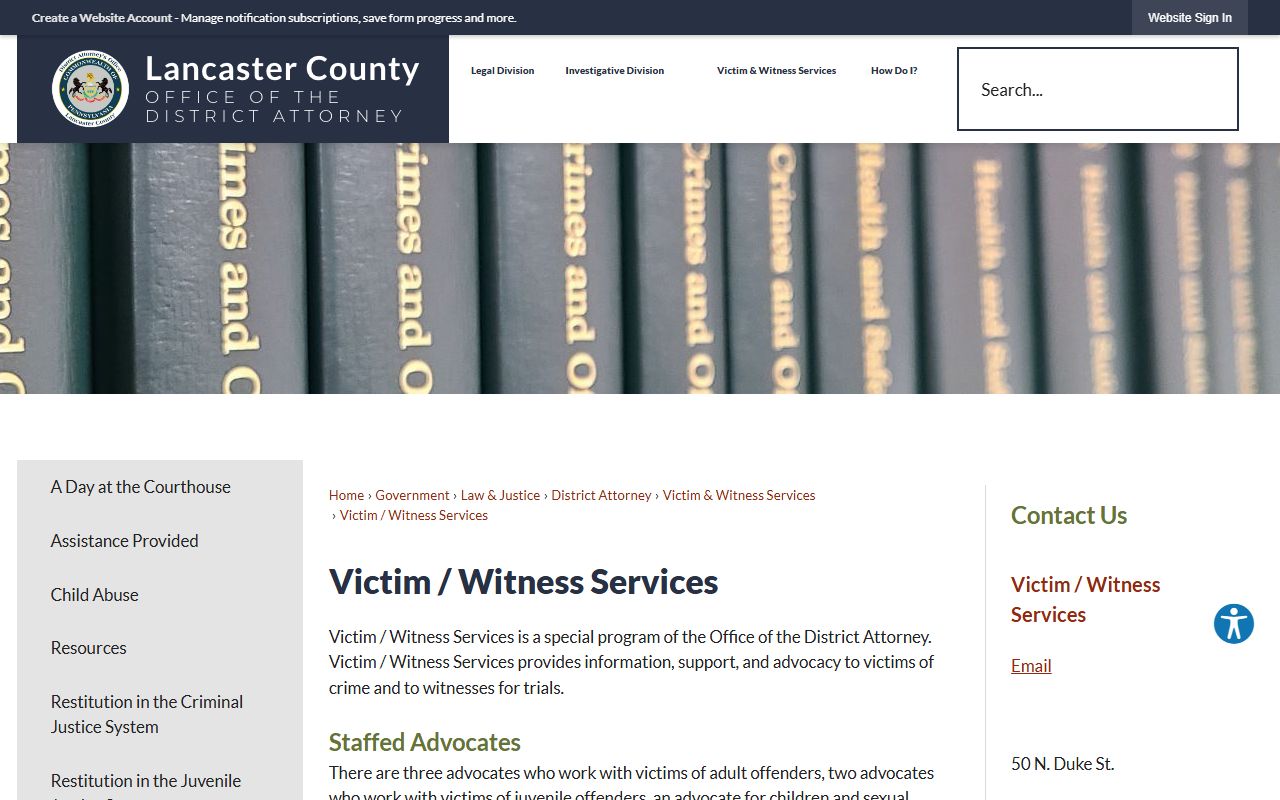
The page explains how advocates help and how to reach them. It is a practical resource for anyone affected by a Lancaster County arrest.
Mugshots and Booking Photos
A mugshot is the booking photo taken during intake. Lancaster County Prison photographs each person during commitment, along with fingerprints and other identifiers. These are correctional and booking records. Not every one of them is published online. The public inmate search shows custody fields, but the reviewed county tool does not openly post a booking photo gallery, so a mugshot may not appear in a basic search.
Be careful with mugshot websites. Private sites repost booking photos and often charge to take them down. They are not official, and they may be out of date. Pennsylvania limits how criminal history can be shared and sold under its records law. For an accurate picture, rely on the county jail, the court docket, and the state police, not a third-party photo site.
A booking photo alone proves an arrest, not guilt. Pair it with the docket to see what came next.
What Is Public and What Is Restricted
Most adult arrest and criminal records in Lancaster County are open to the public. You can search dockets, read charges, and request a county record letter. But the system protects several categories. Juvenile records are generally not public. The Clerk of Courts FAQ lists records involving juveniles as exceptions to public view, and UJS warns that juvenile cases may not display even with the right search terms. Sealed, expunged, and limited-access cases also drop out of public results.
Pennsylvania law draws these lines. The Criminal History Record Information Act, found at 18 Pa.C.S. Chapter 91, controls how criminal history is shared, corrected, and expunged. Juvenile expungement has its own rule. The state's open-records framework treats courts and clerks as judicial agencies, while the District Attorney and Sheriff are not judicial agencies and may follow the normal Right-to-Know process.
- Juvenile cases - generally restricted; contact the court or an attorney.
- Expunged cases - removed from public view after a court order.
- Limited access - sealed for the public but visible to law enforcement and courts.
- Sealed warrants and grand jury - not shown in normal public searches.
- Personal identifiers - Social Security and account numbers are redacted.
You can read the statute that governs criminal history at 18 Pa.C.S. Chapter 91 (CHRIA). The open-records rules for judicial agencies are explained by the Pennsylvania Office of Open Records.
Sealed vs. Expunged Records
Both sealing and expungement limit who can see a record, but they are not the same. Sealing, called limited access in Pennsylvania, hides a record from the general public while law enforcement and the courts can still reach it. Expungement goes further. It removes or destroys eligible records so they are treated as if they never happened, with narrow exceptions for certain agencies. Pennsylvania's Clean Slate law also created automatic limited access for some older, lower-level records.
Both are legal processes, not a clerk deleting a file on request. You file a petition with the Clerk of Courts. You must attach a state police background check, list the correct docket and OTN information, and meet the statutory eligibility rules. The table compares the two paths.
| Sealed (Limited Access) | Expunged | |
|---|---|---|
| Visibility | Hidden from public view | Removed or destroyed; treated as if it never existed |
| Law Enforcement | Still has access | Very limited access |
| Pennsylvania Term | Limited access / Clean Slate | Expungement under 18 Pa.C.S. 9122 |
| Eligibility | Some misdemeanors and qualifying records after a waiting period | Older categories, no conviction, completed diversion, age-based rules |
In Lancaster County, filing fees for these petitions are $137.00 for adult cases and $36.75 for juvenile cases. A petition can fail for an ineligible offense, a missing background check, wrong docket data, unpaid costs, a new conviction, or filing in the wrong court.
Background Check Considerations
Not every lookup is a legal background check. A casual name search on a public docket is fine for personal curiosity. A formal background check for hiring, housing, or licensing is a different matter and the law treats it differently. For those uses, employers usually need a record from the proper channel, like a PSP PATCH report or a certified Clerk of Courts letter, not a screenshot from a free portal. The federal Fair Credit Reporting Act governs how regulated background reports can be used.
Keep the limits in mind. A Lancaster County Clerk letter covers county convictions only. UJS shows public dockets but may hide sealed or restricted cases. PATCH gives a statewide history. Match the tool to the purpose, and confirm anything important with the office that holds the file.
Important: This site is not a consumer reporting agency under the FCRA, and its information may not be used for credit, employment, tenant, or insurance screening.