
How to Search Lancaster County Court Records
The search starts with the right tool. Civil cases from the Court of Common Pleas run through the Prothonotary's CountySuite Civil Public Search. Criminal, traffic, and Magisterial District Court dockets are searchable on the statewide Pennsylvania UJS Case Search. Probate and marriage records run through the Register of Wills Paperless Search. Each tool is free and open to the public. Pick the system that matches the record, and you skip a lot of dead ends.
Before you start, gather what you have. A name helps. A case, docket, or citation number helps more. Common Pleas dockets begin with CP. Magisterial District Court dockets begin with MJ. The more you bring, the fewer false matches you get. You can reach most of these tools from the Lancaster County Court of Common Pleas site, which is a good first stop for public access links and office contacts.
- Pick the portal that fits the record. Use CountySuite for civil and family cases, UJS for criminal and traffic cases, and Paperless Search for probate and marriage records.
- Enter a party name, or a case, docket, or citation number.
- Narrow the search by court type, county, case category, and a filing date range.
- Open the matching case and read the docket entries.
- Request a certified copy from the filing office if you need one for court or legal use.
For criminal and traffic dockets, the Pennsylvania UJS Case Search covers cases across the state, including Lancaster County. Set the county filter to Lancaster to trim a statewide search down to local results.
Which Office Keeps Each Lancaster County Court Record
Pennsylvania does not use a single court clerk. Lancaster County splits the work among three offices, the local minor courts, and the federal system. The Prothonotary keeps civil records. The Clerk of Courts keeps criminal and juvenile records. The Register of Wills and Clerk of Orphans' Court keeps probate, estate, and marriage records. Magisterial District Judges handle traffic and small claims, and federal cases sit outside the county entirely. Match the record to the custodian and you reach the right counter the first time.
This split is the single most useful fact about court records here. A request sent to the wrong office gets returned or delayed. The table below maps each record type to its office and search tool.
| Record Type | Lancaster County Custodian | Search Tool |
|---|---|---|
| Civil, divorce, custody, PFA, judgments, liens | Prothonotary | CountySuite Civil Public Search |
| Criminal and juvenile | Clerk of Courts | UJS Case Search |
| Probate, estates, marriage, adoptions | Register of Wills / Orphans' Court | Paperless Search |
| Traffic, non-traffic, landlord-tenant, small claims | Magisterial District Courts | UJS Case Search |
| Federal cases | U.S. District Court (Eastern District of PA) | PACER |
Civil work points to the Prothonotary. Criminal questions point to the Clerk of Courts. Estate and marriage matters point to the Register of Wills. Traffic and small civil claims start with a local Magisterial District Judge.
Lancaster County Court Records Search Fields
The UJS Case Search lets you pick a search type before you type anything. That choice changes the rest of the form. Search by docket number if you have one. Search by participant name if you do not. A date-filed search has a 180-day limit on its range, so a wide date window will not work. The table below lists the fields most people use on the statewide portal.
| Field Label | Type | Required | Notes / Format |
|---|---|---|---|
| Search By | Dropdown | Yes | Docket Number, Participant Name, Citation Number, OTN, Complaint Number, Incident Number, Date Filed, Attorney, and more. |
| Docket Number | Text | If selected | CP for Common Pleas cases; MJ for Magisterial District Court cases. |
| Citation Number | Text | If selected | Includes a dash, such as A5368532-1. |
| County | Dropdown | Optional | Choose Lancaster to narrow a statewide search. |
| Case Status | Dropdown | Optional | Active, Active/Disposed, Adjudicated, Closed, Inactive, and related values. |
| Date Filed range | Date | If date search | mm/dd/yyyy; a 180-day limit applies to date-filed searches. |
The Prothonotary's CountySuite portal works the same way for civil cases. It lets you search by name or case number, by participant name, by participant address, or by reference number. Advanced filters add a date range, a case category, a judgment-only checkbox, and an option to include attorneys in a name search. For a case under a common name, the category and date filters cut the noise fast.
Types of Lancaster County Court Records
Lancaster County court records cover most of the cases a court can hear. Civil records sit with the Prothonotary and run through CountySuite. They include contract claims, real property actions, professional liability, mass tort, mechanics liens, tax liens, name changes, and appeals from the minor courts. Criminal records sit with the Clerk of Courts and show charges, bail, motions, sentencing, and appeals. Family records cover divorce, custody, and Protection from Abuse cases, all filed on the civil side. Estate and probate records sit with the Register of Wills.
Not every record is treated the same way. Some case types carry tighter access rules than others. The list below sorts the main groups by where they sit.
- Civil records - filed with the Prothonotary; complaints, judgments, liens, and civil appeals.
- Criminal records - filed with the Clerk of Courts; charges, bail, dispositions, and sentences.
- Family and divorce records - civil filings handled by the Prothonotary; see marriage and divorce records.
- Probate and estate records - kept by the Register of Wills and Clerk of Orphans' Court.
- Traffic records - mostly Magisterial District Court cases, searchable on UJS.
- Judgments and liens - tax liens, abstracts of judgment, and writs filed on the civil side.
What Lancaster County Court Records Show
A docket sheet is the spine of a court record. It lists the case number, the parties, and every filing and event in date order. For a criminal case, it can also show the charges, the statute cited, the offense tracking number, bail, and the disposition. For a civil case, it can show the claim, the judgment, and any liens. Traffic cases add the citation number, the plea, and the fines or costs due. The table breaks down the fields you will see most often when you open a Lancaster County case.
| Field | What It Shows |
|---|---|
| Case Number | The unique docket ID; CP for Common Pleas and MJ for Magisterial District Court. |
| Filing Date | The date the case opened or the complaint was filed. |
| Parties | Names and roles, such as plaintiff, defendant, petitioner, or the Commonwealth. |
| Charges / Cause | The statute, grade, and the charge or civil claim. |
| Disposition | The outcome of a charge, claim, or case. |
| Sentence / Judgment | The penalty, money award, costs, fines, or restitution. |
| Docket Entries | Every order, motion, hearing, continuance, payment, and appeal in date order. |
Some terms trip up new readers. A charge is not a conviction. A disposition is the outcome. A continuance is a delay. An OTN, or offense tracking number, ties together the charges in a criminal case across the system. The court dockets page goes deeper into reading these entries line by line.
Public Access Laws for Lancaster County Court Records
Most Lancaster County court records are open to the public, but court files do not follow the same rules as ordinary county paperwork. Courts, clerks, prothonotaries, and the clerk of Orphans' Court are treated as judicial agencies. They give out financial records under a court rule and case records under the statewide public access policy. The county routes court-related open-records questions to its Rule 509 Open Records Officer. Other offices, such as the Sheriff and the District Attorney, are not judicial agencies and may follow the normal Right-to-Know process.
A handful of laws shape what is public and what is sealed. The Pennsylvania Right-to-Know Law in Title 65 sets access rights, response deadlines, and appeals for local agency records. The Criminal History Record Information Act in 18 Pa.C.S. Chapter 91 controls how criminal history is shared, corrected, and expunged. The Judicial Code in 42 Pa.C.S. sets court jurisdiction and the rules for juvenile and Orphans' Court matters. State guidance from the Office of Open Records on judicial agencies explains why court records follow Rule 509 instead of the ordinary process.
The state's open-records and criminal-history rules are published in full online. The Crimes Code chapter that governs criminal history record information is one of the most important for anyone running a background check.
You can read the criminal history statute on the official Pennsylvania General Assembly page for Chapter 91, the source of the rules below.
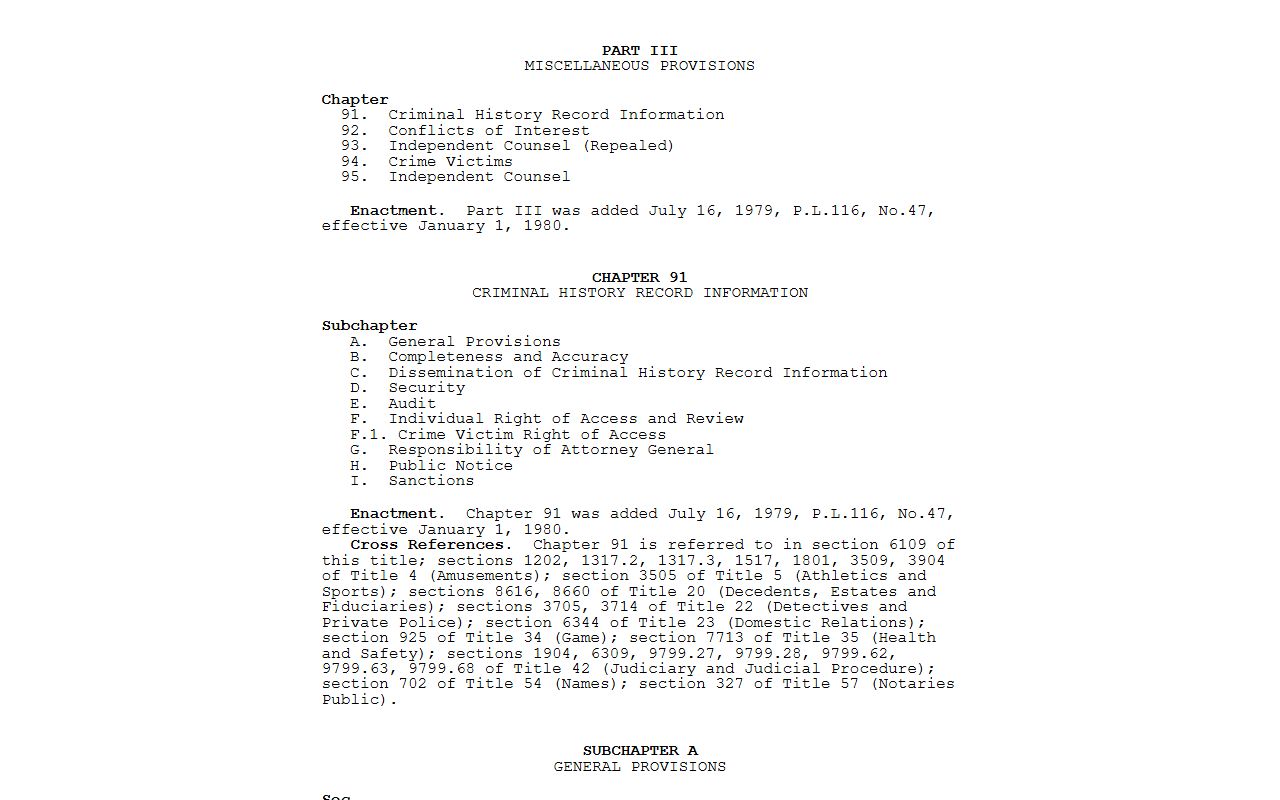
That chapter sets how charges, dispositions, and expungements are shared, which is why a record check returns only what the law allows to be released.
Note: Court records are handled under judicial rules, so a financial-record request goes to the Rule 509 Open Records Officer, not the standard county channel.
Records That Are Sealed or Confidential in Lancaster County
Some Lancaster County court records are closed to the general public. Juvenile cases usually do not show in a public search. Expunged and limited-access cases are removed from open view, though law enforcement and the courts may still see them. Adoption files, mental health commitments, and sealed search warrants are also kept private. Social Security numbers and financial account numbers are redacted under the public access policy. The UJS portal warns that some cases will not display even with the right search terms, including juvenile, expunged, and Act 5 limited-access cases.
To view a sealed file, a person usually needs to be a party, an attorney, or someone the court has authorized. To clear a record, you file an expungement or limited-access petition with the Clerk of Courts. That process needs a Pennsylvania State Police background check under the court rules and a filing fee. The county lists the filing fee as $137.00 for adult cases and $36.75 for juvenile cases. Act 56 of 2018 widened sealing to cover more offense types, including some first-degree misdemeanors. A petition can fail for an ineligible offense, a missing background check, wrong docket or OTN data, or a new conviction.
Federal Court Records for Lancaster County
Not every case from Lancaster County lands in a county office. Lancaster County sits within the U.S. District Court for the Eastern District of Pennsylvania. Federal cases are not searched in the Prothonotary, the Clerk of Courts, or the UJS portal. They run through PACER and the federal CM/ECF system instead. So a federal lawsuit, a federal criminal case, or a bankruptcy filing needs a different door than a local docket.
The federal trial court for the region is the starting point for most federal civil and criminal matters tied to the county. You can learn its scope on the U.S. District Court for the Eastern District of Pennsylvania site.
That court hears federal civil suits and federal crimes from a multi-county area that includes Lancaster County.
Public access to federal dockets runs through PACER, a paid electronic system that covers appellate, district, and bankruptcy courts. The court explains sign-up and help on its Eastern District PACER page.
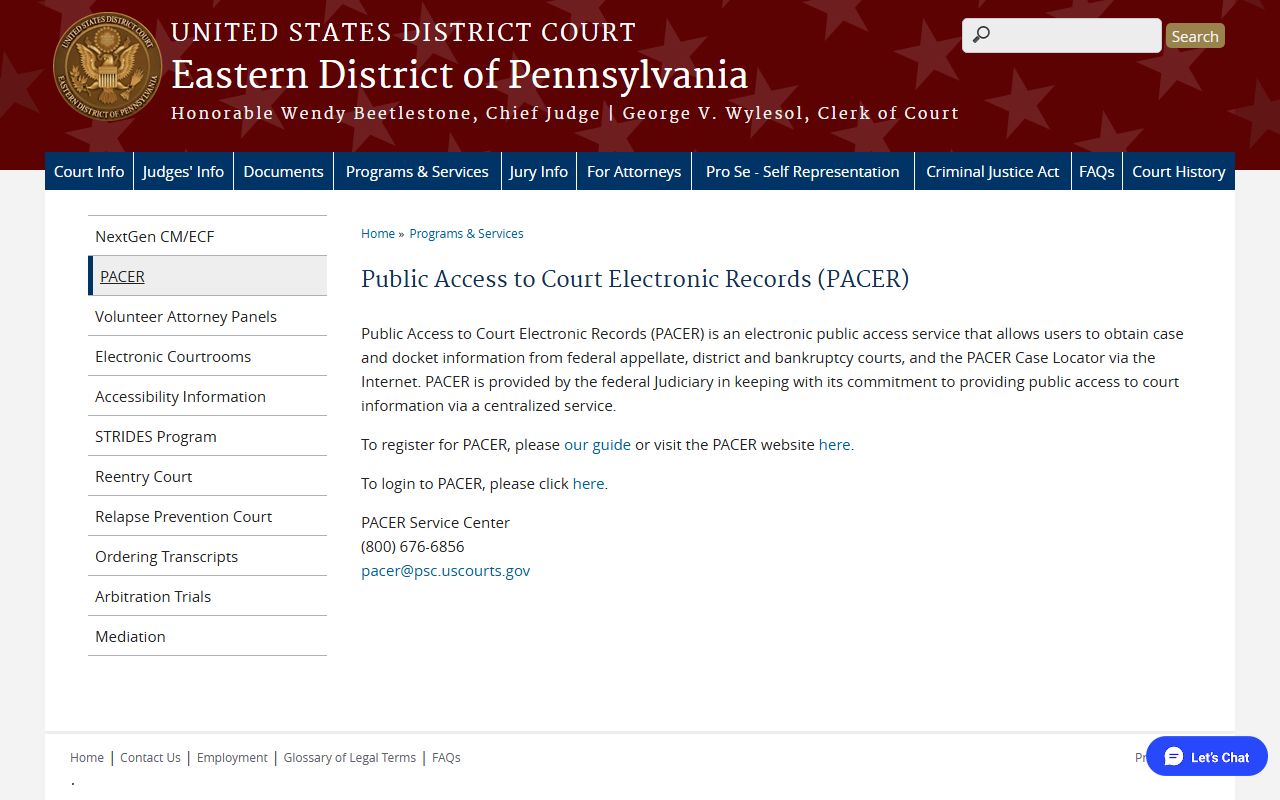
PACER charges a small per-page fee for documents, and the PACER Service Center handles registration and account questions.
Bankruptcy is its own track. A Chapter 7 or Chapter 13 case from the county is filed in the federal bankruptcy court, not the Prothonotary. Details and case access live on the U.S. Bankruptcy Court for the Eastern District of Pennsylvania site.
Bankruptcy cases use the same PACER login as the district court but carry their own docket numbers.
Federal appeals from this region go higher still. The U.S. Court of Appeals for the Third Circuit reviews federal cases from Pennsylvania, including those that started in the Eastern District.
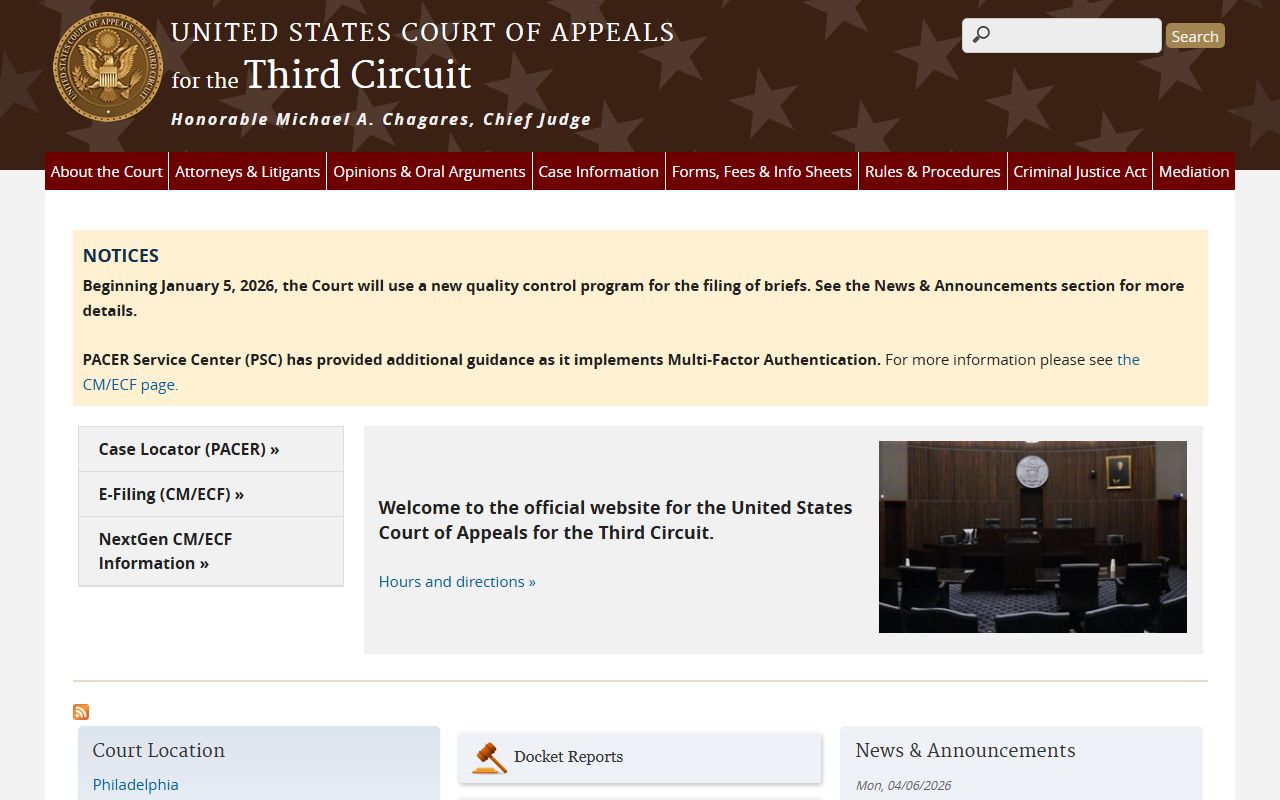
An appeal there reviews the trial court's ruling, not the facts from scratch.
Federal prosecutions in the area are led by the U.S. Attorney's Office for the Eastern District. Its work, news, and contact details are on the U.S. Attorney's Office for the Eastern District of Pennsylvania page.
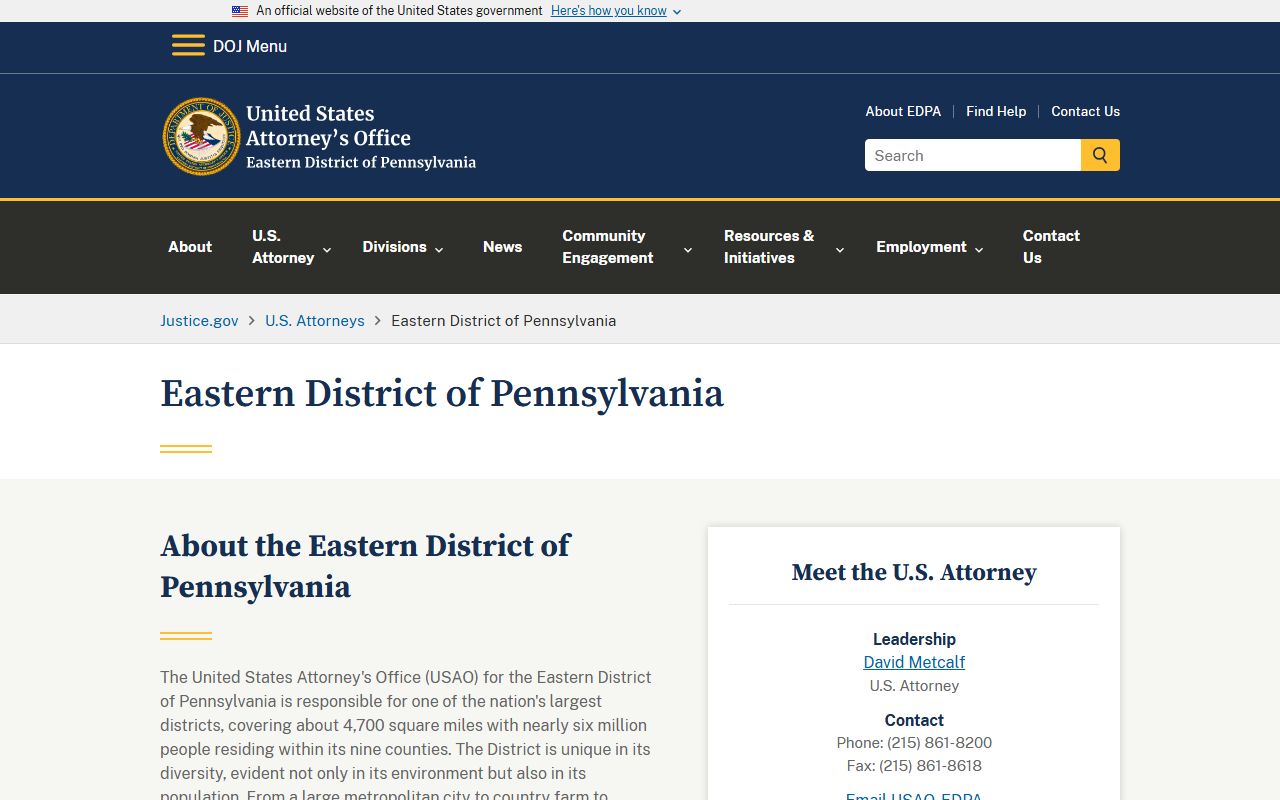
That office covers a nine-county district that includes Lancaster County and handles federal criminal and civil matters involving the United States.
In-Person and Mail Requests for Court Records
Online tools do not show every document. For a certified copy, an older file, or a record not visible on a portal, contact the office that keeps it. The Prothonotary, Clerk of Courts, and Register of Wills all sit in the courthouse at 50 North Duke Street in downtown Lancaster. Plan for security screening at the entrance, and print what you need before you arrive. Public cell phones and recording devices are not allowed inside, and a phone or smart watch may be placed in a Sheriff's pouch until you leave.
Mail requests have their own rules. A Clerk of Courts criminal record check must come by written letter with the subject's name, address, date of birth, and full Social Security number, plus a certified check. Phone requests are not accepted. The office mails back a court-seal letter listing Lancaster County charges and dispositions, or a no-record letter. Copy and certification fees are added on top of the search fee.
Lancaster County Prothonotary
50 N. Duke St.
Lancaster, PA 17602
717-299-8041
Mon-Fri 8:30 a.m.-5:00 p.m.
Lancaster County Clerk of Courts
50 N. Duke St., 2nd Floor
Lancaster, PA 17602
717-299-8275
Filing hours 8:30 a.m.-4:30 p.m.
Fees for Lancaster County Court Record Copies
Fees depend on the office and the record. The Clerk of Courts charges a set fee for a criminal record search and a per-copy fee for documents. The Prothonotary and Register of Wills publish their own fee schedules, so confirm the current amount before you mail a payment. Many offices do not take personal checks. A Clerk of Courts record search, for example, must be paid by certified check made out to the office.
| Item | Amount |
|---|---|
| Criminal record search (Clerk of Courts) | $21.50 per search |
| Certified copy (Clerk of Courts) | $8.75 each |
| Plain copy | $0.25 per page |
| Hard-copy docket sheet or court summary | $0.25 per page |
One result does not always tell the full story. A Clerk of Courts record check shows only Lancaster County convictions. For a statewide criminal history, a person uses the Pennsylvania State Police PATCH system instead.