
Lancaster County Court of Common Pleas Overview
Pennsylvania runs a four-level court system. At the top sits the Supreme Court of Pennsylvania. Below it are two middle courts, the Superior Court and the Commonwealth Court. Then comes the Court of Common Pleas, the trial court of general jurisdiction. At the base are the local minor courts, run by Magisterial District Judges. Lancaster County is the Second Judicial District of the Court of Common Pleas. That means the county forms its own judicial district, and its Common Pleas bench handles the full range of major cases that arise within county lines.
The Court of Common Pleas is where the serious work happens. It hears major civil disputes, felony and misdemeanor criminal cases, divorce and custody, juvenile delinquency and dependency, and Orphans' Court matters such as estates and guardianships. It also reviews appeals from the Magisterial District Courts. You can read the court's mission and public access links on the Lancaster County Court of Common Pleas site. The court says its job is to provide fair, efficient, and trusted justice for the community.
The minor courts sit one level down. They handle the cases most residents are likely to face: traffic tickets, summary offenses, landlord-tenant disputes, and small civil claims. They also run the first steps of a criminal case, such as preliminary arraignments and preliminary hearings, before a felony or misdemeanor moves up to Common Pleas.
Judges of the Lancaster County Court of Common Pleas
The Court of Common Pleas is staffed by a bench of judges who split the work across divisions. The Sheriff's Office duties page notes that deputies provide security for fifteen judges and courtrooms inside the courthouse, along with other court offices. That gives a sense of the court's size. Judges rotate through civil, criminal, family, and Orphans' Court assignments, and a president judge oversees the district's operations.
The court keeps its calendar and scheduling online. The Court Case Calendar lists hearings and court events for the Common Pleas bench. Court operations sit inside the main courthouse, and the public can reach the court office by phone during business hours. For day-to-day filings, though, you deal with one of the filing offices rather than the judges directly.
Three offices keep the court's records. The Prothonotary holds civil and family files. The Clerk of Courts holds criminal and juvenile files. The Register of Wills and Clerk of Orphans' Court keeps probate, estate, and marriage records.
Lancaster County Magisterial District Courts
Below the Court of Common Pleas sit the Magisterial District Courts, run by Magisterial District Judges, or MDJs. These are the county's minor courts, and they are spread across towns from Columbia to New Holland to Quarryville. Each MDJ covers a numbered district and handles the everyday cases: traffic citations, summary offenses, landlord-tenant disputes, and small civil claims. They also run preliminary arraignments and preliminary hearings, the first steps in a criminal case before it reaches Common Pleas.
The statewide judiciary publishes a current list of every Magisterial District Judge, with addresses and phone numbers. You can view it on the Magisterial District Judge print-view page.
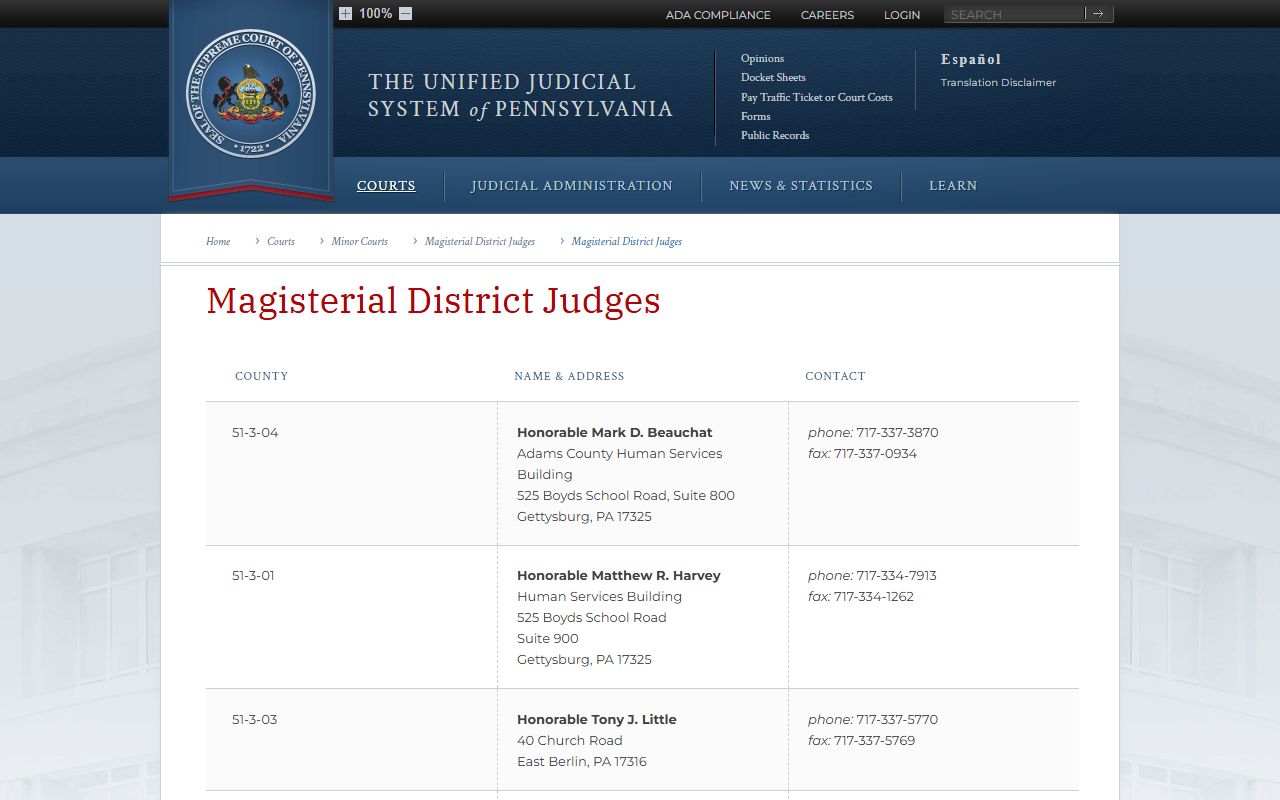
The list confirms each judge's district number, office address, and phone. The table below pulls the Lancaster County rows from that source so you can find the right minor court near you.
| District | Judge | Address | Phone |
|---|---|---|---|
| 02-1-01 | Hon. Adam J. Witkonis | 641 Union Street, Lancaster, PA 17603 | 717-299-7896 |
| 02-1-02 | Hon. Courtney M. Monson | 2205 Oregon Pike, Lancaster, PA 17601 | 717-569-8774 |
| 02-1-03 | Hon. Miles K. Bixler | 341 Chestnut Street, Columbia, PA 17512 | 717-684-2761 |
| 02-2-01 | Hon. Jodie E. Richardson | 123 Locust Street (Rear), Lancaster, PA 17602 | 717-299-7974 |
| 02-2-02 | Hon. John E. Bender | 150 North Queen Street, Suite 120, Lancaster, PA 17603 | 717-295-2000 |
| 02-2-03 | Hon. Mary Mongiovi Sponaugle | 1351 Elm Avenue, Lancaster, PA 17603 | 717-299-7898 |
| 02-2-04 | Hon. Andrew T. LeFever | 796-A New Holland Avenue, Lancaster, PA 17602 | 717-299-7966 |
| 02-2-05 | Hon. Brian E. Chudzik | 2168 Embassy Drive, Suite 150, Lancaster, PA 17603 | 717-898-2511 |
| 02-2-06 | Hon. Joshua R. Keller | 841 Stehman Road, Millersville, PA 17551 | 717-872-4361 |
| 02-2-07 | Hon. Torrey J. Landis | 609 East Main Street, Ephrata, PA 17522 | 717-733-8688 |
| 02-2-08 | Hon. Joseph C. Stauffer | 690 Furnace Hills Pike, Lititz, PA 17543 | 717-626-0258 |
| 02-3-01 | Hon. Michael D. Hess | 424 South Angle Street, Mount Joy, PA 17552 | 717-653-4575 |
| 02-3-02 | Hon. B. Denise Commins | 15 Geist Road, Lancaster, PA 17601 | 717-656-2191 |
| 02-3-03 | Hon. William E. Benner Jr. | 324 Beaver Valley Pike, Willow Street, PA 17584 | 717-464-4141 |
| 02-3-04 | Hon. William R. Mankin II | 25 East State Street, Quarryville, PA 17566 | 717-786-7368 |
| 02-3-05 | Hon. Raymond S. Sheller | 3 Heritage Drive, Suite 100, Gordonville, PA 17529 | 717-768-3312 |
| 02-3-06 | Hon. Jonathan W. Heisse | 745B East Main Street, New Holland, PA 17557 | 717-354-4206 |
| 02-3-07 | Hon. Clark A. Bearinger | 935 Stone Hill Road, Denver, PA 17517 | 717-336-2801 |
| 02-3-09 | Hon. Frank H. Ember Jr. | 5 Municipal Drive, Elizabethtown, PA 17022 | 717-367-4330 |
District numbers start with 02, the code for the Second Judicial District. Each MDJ office takes filings and payments for cases in its area. If you have a ticket or a small claim, the district that covers your town is your first stop.
Note: Magisterial District Court dockets begin with the MJ prefix, while Court of Common Pleas dockets begin with CP, so the prefix tells you which court holds the case.
Court of Common Pleas vs. Magisterial District Court
The two levels of court do very different jobs. The Court of Common Pleas is the trial court of general jurisdiction, so it can hear nearly any kind of case. The Magisterial District Court is a minor court with limited authority, built for fast, low-cost handling of small matters. Knowing the split keeps you from filing in the wrong place. A felony belongs in Common Pleas. A speeding ticket belongs with an MDJ. The table compares the two side by side.
| Court of Common Pleas | Magisterial District Court | |
|---|---|---|
| Case Types | Major civil, criminal, family, juvenile, Orphans' Court | Traffic, summary offenses, landlord-tenant, small civil claims |
| Jurisdiction | General; the county's main trial court | Limited; minor cases and the start of criminal cases |
| Where Appeals Go | Superior Court or Commonwealth Court, then the Supreme Court of Pennsylvania | Up to the Court of Common Pleas |
| Examples | Divorce, felony trial, estate, custody, foreclosure diversion | Speeding ticket, eviction, small claim, preliminary hearing |
Criminal cases often touch both levels. A felony usually starts with an MDJ for the preliminary arraignment and preliminary hearing. If the case clears that step, it moves up to the Court of Common Pleas for trial. So a single case can pass through more than one court before it ends.
How a Case Moves Through the Lancaster County Court System
Cases climb the court ladder one rung at a time. A minor case can begin and end with a Magisterial District Judge. A bigger case starts there too but moves up, and either side can appeal a final ruling to a higher court. The flow below traces the path a case can take from the bottom of the system to the top.
Case path: Magisterial District Court › Court of Common Pleas › Superior Court or Commonwealth Court › Supreme Court of Pennsylvania
Appeals split into two tracks at the middle level. The Superior Court hears most criminal, family, and private civil appeals from the Court of Common Pleas. The Commonwealth Court hears matters that involve state and local government, administrative agencies, and election law. Both feed into the Supreme Court of Pennsylvania at the top. Appeals from a Magisterial District Judge, by contrast, go up to the Court of Common Pleas, not straight to a middle court.
- A minor case or the first stage of a criminal case starts with a Magisterial District Judge.
- Major cases, and MDJ appeals, are heard by the Court of Common Pleas.
- A final Common Pleas ruling can be appealed to the Superior Court or the Commonwealth Court.
- The Supreme Court of Pennsylvania has the last word on cases it agrees to review.
Divisions of the Lancaster County Court of Common Pleas
The Court of Common Pleas does not work as one undivided court. The work is grouped so the right judge and the right filing office handle each kind of case. Civil and family cases run through the Prothonotary. Criminal and juvenile cases run through the Clerk of Courts. Estate, guardianship, and marriage matters run through the Register of Wills and Clerk of Orphans' Court. The division you need depends on what the case is about.
Civil work covers a wide range. It includes contract claims, real property actions, professional liability, mass tort, mechanics liens, and tax liens. Family cases such as divorce, custody, and Protection from Abuse are filed on the civil side as well. You can see how these records are searched on the court records page, and learn how to read a case file on the court dockets page.
Criminal cases are tracked by the Clerk of Courts, the chief filing office for the Criminal Division. That office records charges, bail, motions, sentencing, and appeals to the higher courts. For booking and arrest information, the arrest records page goes into more detail on how a criminal case begins.
Lancaster County Courthouse and Security
The Court of Common Pleas sits in the Lancaster County Courthouse at 50 North Duke Street in downtown Lancaster. The building holds the courtrooms along with the core filing offices and Law Library access. The court office answers at 717-299-8041, and public hours run Monday through Friday, 8:30 a.m. to 5:00 p.m. If you plan to visit a courtroom or a filing counter, this is the address to use.
Security is tight, and you should plan for it. Sheriff's deputies screen the public at the courthouse entrance using magnetometers and x-ray machines. The Sheriff's Office says deputies screen about 1,500 people and scan about 1,300 items each day to keep contraband out. That volume means lines can form, so arrive early for a hearing or a filing deadline.
Electronics are limited inside. Public cell phones and audio-video recording devices are not allowed in court facilities. The county notes that a phone or smart watch brought into the courthouse may be placed in a Sheriff's security pouch until you leave. Print any case numbers, confirmations, or payment details before you arrive, because you cannot count on a phone in the building.
Lancaster County Court of Common Pleas
50 N. Duke St.
P.O. Box 83480
Lancaster, PA 17608
717-299-8041
Mon-Fri 8:30 a.m.-5:00 p.m.
Specialty Diversion Programs in Lancaster County
The Court of Common Pleas runs two civil diversion programs that change how some cases move through the docket. Both are court-supervised tracks meant to bring parties together before a case turns into full litigation. They are listed as popular pages on the court's own site, and they show up as case categories in the civil search system.
The Residential Mortgage Foreclosure Diversion Program puts homeowners, lenders, and lawyers into a structured process before an ordinary foreclosure case proceeds. The Consumer Credit Collections Diversion Program does the same for some credit-card collection cases. If you see diversion terms on a civil docket, this is why. The Court of Common Pleas site lists both programs under its public links.
People who cannot afford a lawyer in a criminal case may qualify for the County of Lancaster Public Defender's Office. Christopher Tallarico serves as the appointed Public Defender. Pennsylvania law requires every county except Philadelphia to fund a public defender system, and the Lancaster office handles adult criminal cases, probation and parole violations, appeals, and juvenile delinquency cases.
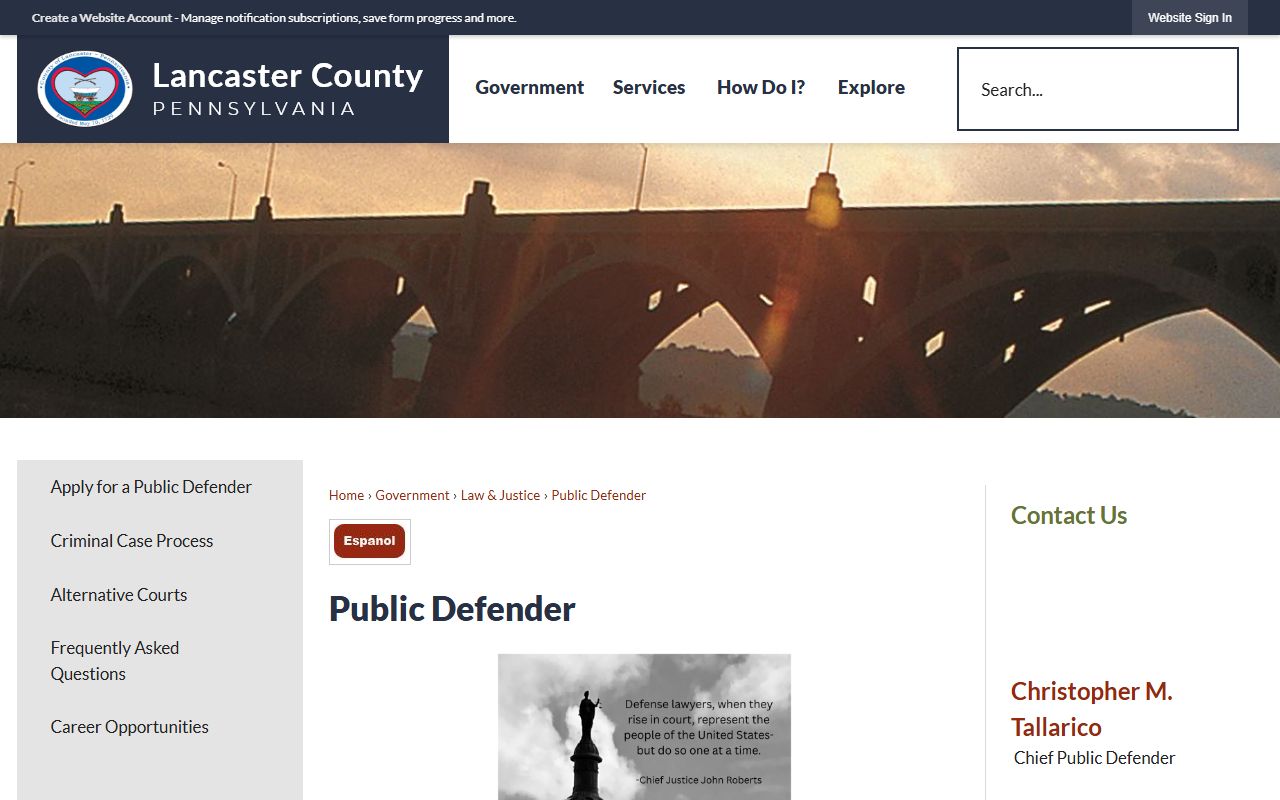
The page lists the office address and contact so a person facing charges can reach assigned counsel.
Lancaster County Public Defender
150 N. Queen St., Suite 210
Lancaster, PA 17603
717-299-8131
Mon-Fri 8:30 a.m.-5:00 p.m.
Appeals From the Lancaster County Court of Common Pleas
An appeal is a request to a higher court to review a decision. From the Court of Common Pleas, the path depends on the kind of case. Criminal, family, and most private civil appeals go to the Superior Court. Cases that involve state or local government, administrative agencies, or election law go to the Commonwealth Court instead. From either of those middle courts, a party can ask the Supreme Court of Pennsylvania to take the case, though the high court chooses which appeals it will hear.
The filing offices handle the paperwork. The Clerk of Courts processes criminal appeals to the Superior and Supreme Courts. The Prothonotary processes civil appeals. The judiciary describes each court's role on the statewide Pennsylvania courts page, and the rules that set court jurisdiction live in the Judicial Code.
You can read the Judicial Code, which governs court jurisdiction and appeals across Pennsylvania, on the official statute page.
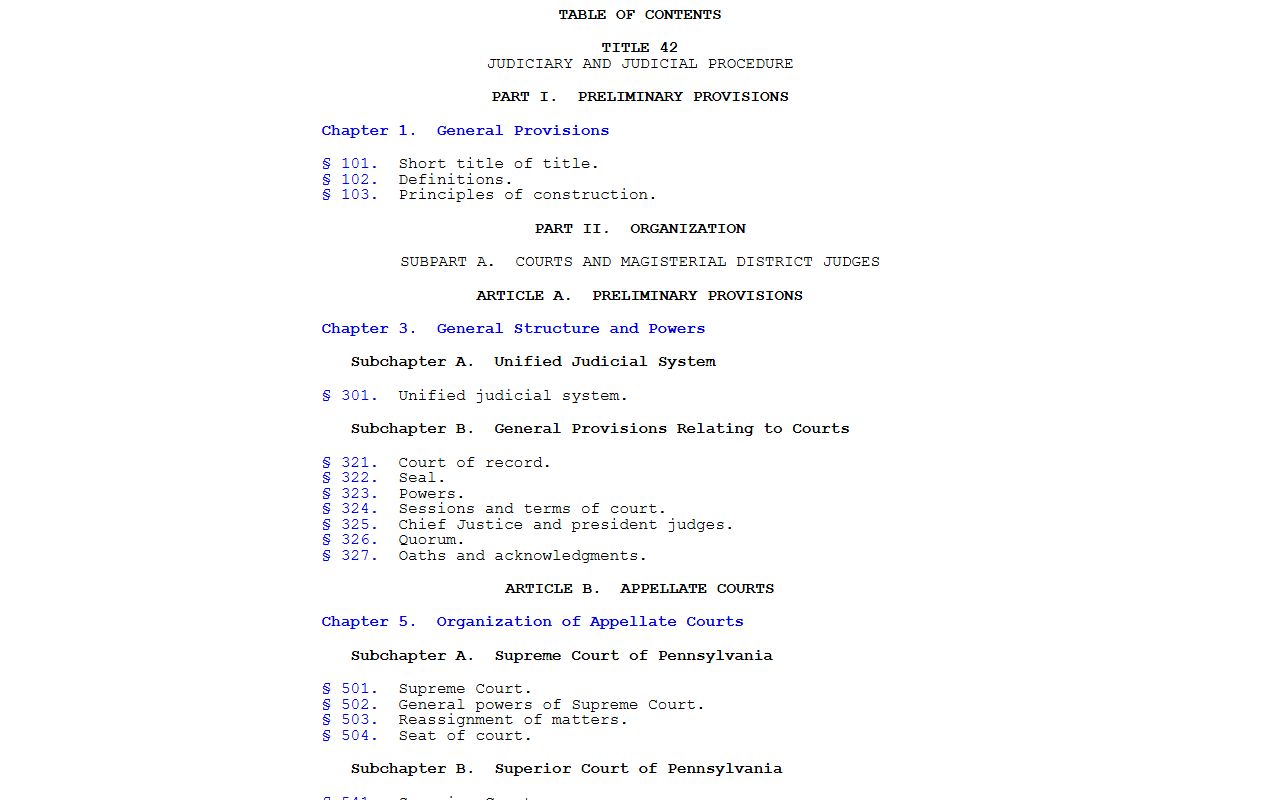
That code, found at 42 Pa.C.S., sets the jurisdiction of the trial courts, the appellate courts, and the rules for juvenile and Orphans' Court matters.
Key Court of Common Pleas Terms
Court paperwork is full of terms that trip up new readers. A few short definitions make a docket easier to follow. These come up often on Lancaster County filings, whether civil or criminal.
- Court of Common Pleas
- Pennsylvania's trial court of general jurisdiction; Lancaster County is the Second Judicial District.
- Magisterial District Judge
- A local minor-court judge who handles traffic, summary offenses, small claims, and preliminary criminal steps.
- Prothonotary
- The civil filing office for the Court of Common Pleas.
- Clerk of Courts
- The criminal and juvenile filing office for the Court of Common Pleas.
- Orphans' Court
- The division that handles estates, guardianships, and adoptions.
- Disposition
- The outcome of a charge, claim, or case.